Please see below a brief Primer on AI Financing Structures based on the next image (source: Coatue) with special thanks to @Todor Kostov
Key Takeaways:
- The AI infrastructure boom is usually presented as a simple capex story: hyperscalers spend billions building data centers and buying GPUs.
- But the financing model is becoming much more sophisticated. What began as straightforward corporate investment is evolving into a multi-layered ecosystem involving hyperscalers, neoclouds, chipmakers, private-credit funds and special-purpose vehicles (SPVs).
- The key implication is that AI infrastructure investment and hyperscaler-reported capex are no longer necessarily the same thing.
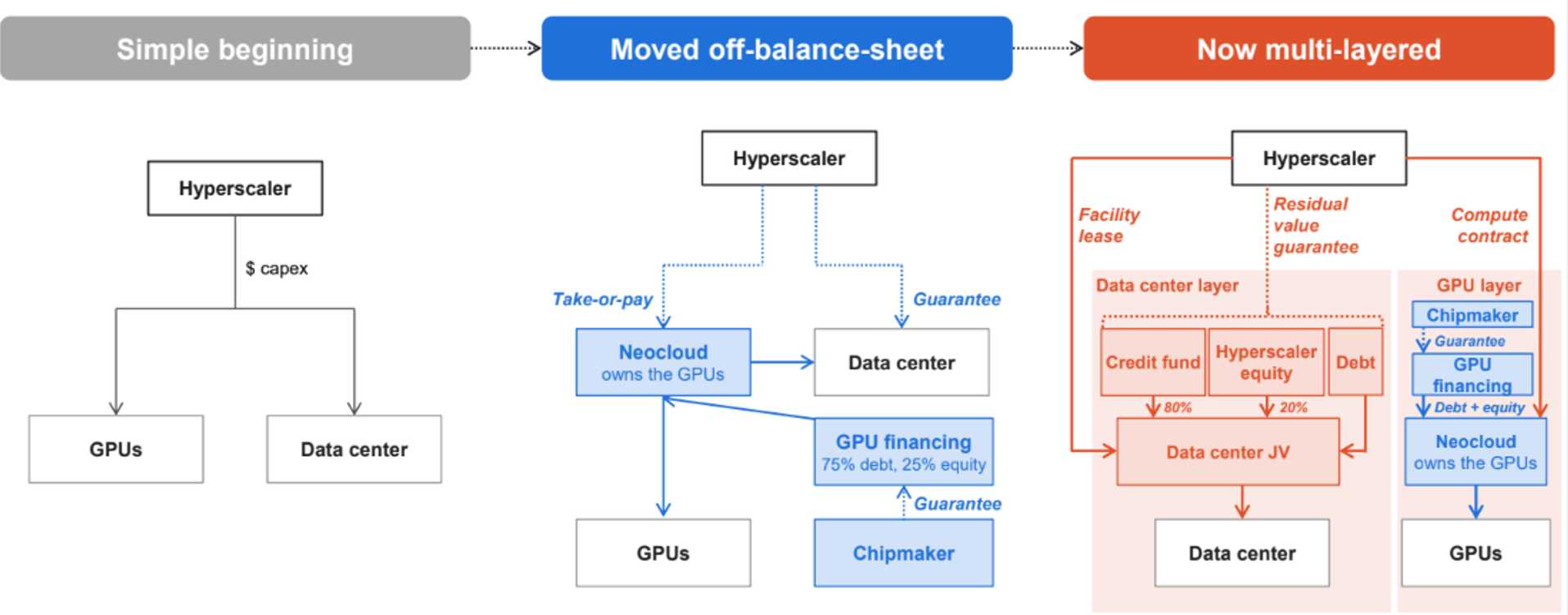
1. Simple Beginning: hyperscaler pays for everything
Initially, the structure was simple:
Hyperscaler → Capex → Data centers + GPUs
The hyperscaler built the data center, purchased the GPUs and carried the assets on its balance sheet.
If a new AI campus required $15bn-$10bn for the facility and $5bn for GPUs-the hyperscaler might simply spend the entire $15bn.
Transparent, but extremely capital-intensive.
2. Moving GPUs off-balance-sheet
The next step introduces the neocloud.
Instead of purchasing GPUs directly, the hyperscaler signs a long-term take-or-pay or compute contract with a neocloud, which purchases and owns the GPUs.
Hyperscaler → Compute commitment → Neocloud → GPUs
The contract creates predictable revenue, allowing the neocloud to finance its GPU fleet with a combination of equity and debt. For example, a $4bn GPU fleet might be financed with $1bn equity and $3bn debt.
The hyperscaler hasn't eliminated its economic exposure. It has effectively transformed upfront capex into a contractual commitment.
Beware GPUs create an additional financing challenge: technological obsolescence can make their residual value highly uncertain. Chipmakers can therefore provide guarantees or other forms of credit support to GPU financing.
The financing stack can now contain:
- Neocloud equity as first-loss capital
- Debt providing most of the funding
- Hyperscaler contracts supporting revenues
- Chipmaker guarantees/backstops reducing lender risk
These layers can make increasingly large GPU purchases financeable with leverage.
3. Multi-layered Financing: Detaching Data centers and GPUs
The newest structures can separate the physical data center from the GPUs entirely.
The data center may sit inside a dedicated JV/SPV, financed by hyperscaler equity, private credit and debt. The hyperscaler then signs a long-term facility lease.
Investors → Data Center JV → Data center
Hyperscaler → Long-term lease → Data Center JV
The lease provides predictable cash flows that support the project's debt. The hyperscaler may also provide a residual-value guarantee, reducing investors' risk if the facility is worth less than expected when the lease ends.
Meanwhile, the GPUs sitting inside the building can belong to an entirely different company-the neocloud-with their own financing.
So one AI campus effectively contains two financing systems:
| Data-center layer |
GPU layer |
| Data Center JV/SPV |
Neocloud |
| Private credit + debt |
GPU debt |
| Hyperscaler equity |
Neocloud equity |
| Facility lease |
Compute contract |
| Residual-value support |
Chipmaker guarantee |
Where did the risk go?
It didn't disappear. It was redistributed.
Construction and financing risk can migrate to infrastructure investors and credit funds. GPU ownership and obsolescence risk can move toward neoclouds, lenders and chipmakers. Meanwhile, hyperscalers can retain substantial economic exposure through leases, take-or-pay agreements, compute contracts and guarantees.
This distinction matters:
Accounting ownership ≠ economic exposure.
A hyperscaler doesn't necessarily need to own an asset to make the contractual commitment that makes financing that asset possible.
Why investors should care
This evolution has three major consequences.
- Reported hyperscaler capex may increasingly understate the total AI infrastructure being built around them. Some investment occurs on third-party balance sheets.
- AI is becoming a private-credit and structured-finance story. Debt and outside capital can amplify the amount of infrastructure supported by each dollar of hyperscaler equity.
- Leverage makes the location of risk harder to see. The system works well while compute demand remains strong, contracts are honored and GPU residual values remain sufficient. A downturn would reveal who ultimately absorbed the risk.
The AI infrastructure cycle is therefore evolving from:
Corporate capex → Asset finance → Project finance → Structured finance
The important question for investors is no longer just:
"How much are hyperscalers spending on AI?"
It is increasingly:
"How much infrastructure is being financed around hyperscaler commitments-and who ultimately carries the risk?"
------------------------------
Carlos Salas
Portfolio Manager & Freelance Investment Research Consultant
------------------------------