Very interesting development in LLM models.
TypeSafe's Jev, is a new type of LLM designed to make fast decisions rather than generate text. TypeSafe calls this category a "System One" model referencing Daniel Kahneman's fast, intuitive System 1 thinking . Instead of producing an answer word by word like a traditional LLM, Jev receives information, evaluates several predefined questions at once, and returns structured answers with confidence probabilities.
Key Takeaways:
- Jev is a decision model, not a chatbot. It is designed for tasks such as classification, scoring, routing, and automated decision-making where the possible answers are known beforehand. It is not suitable for writing, coding, summarization, or other open-ended tasks.
- It is extremely fast and cheap. TypeSafe reports response times of roughly 70–500 milliseconds, making Jev suitable for high-volume or near-real-time applications.
- Its answers are structured by design. Developers define the possible outputs in advance e.g. choosing a category, assigning a score, or estimating a yes/no probability. This prevents malformed outputs and type errors.
- Every answer comes with a confidence level. This makes it possible to automate high-confidence decisions while sending uncertain cases to a human or a more powerful LLM designed for system two tasks.
- The trade-off is that Jev cannot explain itself in natural language. It gives a decision and probability, but not a written explanation of why it reached that conclusion. This can be problematic when decisions need to be audited or explained.
- Performance appears competitive for its intended tasks. TypeSafe reports about 67.8% accuracy, similar to GPT-5.6 Terra in its tests, but at a fraction of the cost and latency. However, these benchmarks come from TypeSafe itself and have not yet been independently validated.
The most interesting use may therefore be combining Jev with conventional LLMs: Jev handles millions of simple decisions quickly and cheaply, while difficult or low-confidence cases are passed to a larger LLM for deeper reasoning and explanation. In that sense, Jev is better understood as a fast decision layer alongside LLMs rather than a replacement for them.
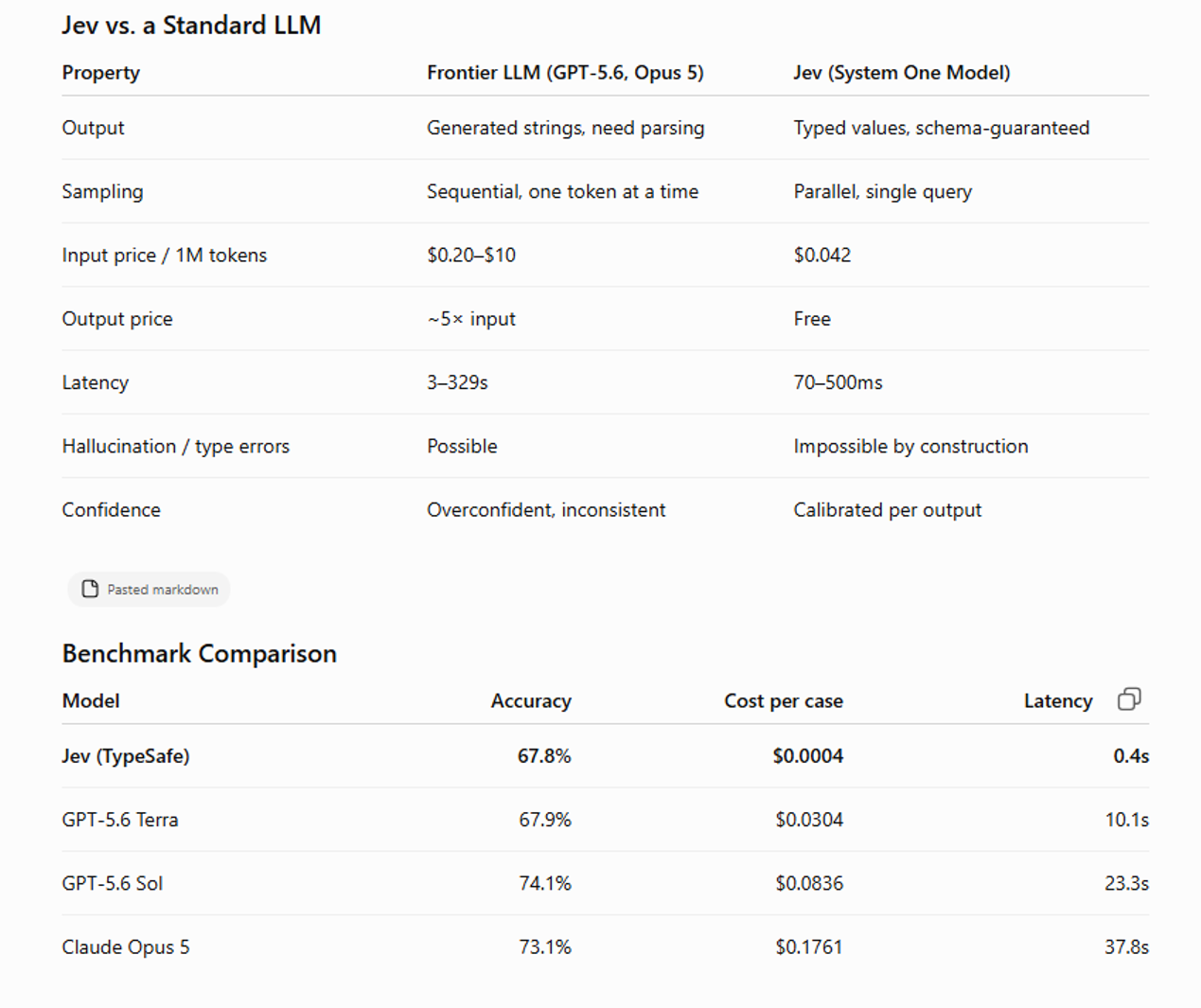
It's important to understand the difference between system one models like Jev and system two peer models:
- Jev handles the probabilistic decision layer
- GPT/Claude/Gemini-style models handle the generative reasoning and explanation layer.
- These as complementary classes rather than Jev simply replacing general-purpose LLMs.
Some Investment Use Cases comparing system one vs system two tasks:
One important distinction is that the Jev questions need to have a bounded answer space. For example, rather than asking "What do you think about this company?", you might define:
Material deterioration? → {Yes, No}
Risk severity? → Score 0–100
Event category? → {Earnings, Accounting, Management, Regulatory, M&A, Other}
Needs LLM investigation? → {Yes, No}
Jev can then return those decisions with calibrated probabilities, while an LLM handles the subsequent "why?" and "what does this mean for the investment thesis?" questions.
That distinction follows directly from the source's bounded-decision versus open-ended-reasoning framework.
Links
Introducing System One Models & Jev - TypeSafe AI Blog
Home - TypeSafe AI
------------------------------
Carlos Salas
Portfolio Manager & Freelance Investment Research Consultant
------------------------------