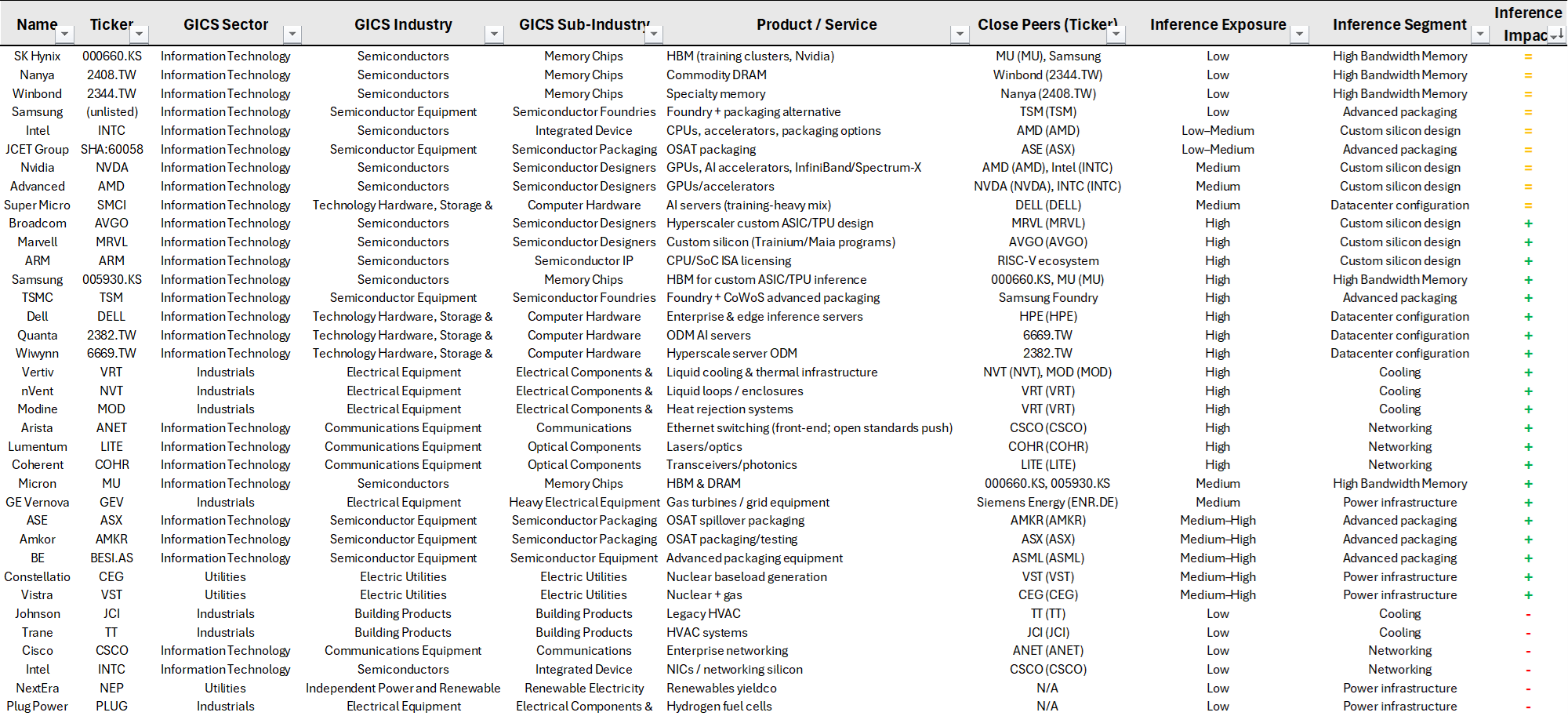
Please see below some insights on inference as new secular trend within the GenAI megatrend along with a table summarizing key players. Hope is helpful and do not hesitate to comment or provide any corrections.
Inference New Era
The AI value chain is undergoing a structural rotation from training-centric compute (2023–2025) to inference-dominant workloads (2025–2028). This is not a cyclical slowdown but a change in the economic center of gravity.
What just ended (Training Era):
- AI economics were dominated by one-off, capital-intensive training runs.
- Performance mattered more than cost: Nvidia's general-purpose GPUs (H100) won decisively.
- Result: Nvidia data center revenue exploded ($15B → $115B in two years).
- Ecosystem beneficiaries: TSMC (fabs), SK Hynix (HBM), advanced packaging, power & cooling.
- But training is episodic, not linear. Each new model is a discrete CapEx cycle with diminishing marginal gains due to data saturation.
What's starting now (Inference Era)
- Inference is now the majority of workloads, driven by:
- Agentic workflows (one task → hundreds/thousands of model calls)
- Continuous, always-on AI usage instead of single queries
- Inference economics are brutally price-sensitive:
- $0.01 vs $0.001 per query = 10× annual cost difference at scale
- Switching costs are minimal → commoditization risk
- This favours:
- Specialized silicon (ASICs, TPUs, LPUs) over expensive general-purpose GPUs.
- Distributed, latency-optimized infrastructure (edge + on-prem).
- Nvidia doesn't disappear-but faces a margin and expectations reset as the "Nvidia tax" becomes untenable at inference scale.
Capital flows rotate, not disappear
Training-era profits don't vanish; they re-distribute:
- From GPUs → custom silicon designers
- From centralized clusters → packaging, optics, cooling, power, and edge infrastructure
- From variable renewables → baseload nuclear and gas
------------------------------
Carlos Salas
Portfolio Manager & Freelance Investment Research Consultant
------------------------------